The Patel Breach Proves Cloud Accounts Can't Protect High-Value Files
When even FBI directors get hacked, professionals need hardware-secured, offline storage for sensitive files—not cloud accounts vulnerable to nation-states.
When Personal Email Accounts Become National Security Incidents
FBI Director Kash Patel's personal email account was breached by Handala, a pro-Iranian hacking group. They posted decade-old photos, travel records, and business documents online. The FBI confirmed the breach but hasn't disclosed when the compromise occurred—only that Patel was warned in December 2024 that Iranian hackers had targeted him.
The response from security professionals was predictable: better passwords, enable MFA, use secure email providers. All true, all helpful, all insufficient. The real lesson isn't about email hygiene. It's about the fundamental architecture of how professionals store sensitive information in an era where nation-state adversaries routinely compromise accounts that were supposed to be secure.
Patel's breach joins a growing list of high-profile account compromises—from Treasury Department officials to telecommunications executives. The common thread isn't weak passwords or phishing victims. It's the reality that any account accessible over a network is, by definition, accessible to sophisticated adversaries with sufficient motivation and resources.
Why Network-Connected Storage Has Become Untenable for High-Risk Professionals
The threat landscape has fundamentally shifted in ways that make traditional approaches to sensitive file storage inadequate.
Nation-state actors now operate persistent campaigns targeting specific individuals years before those individuals reach positions of significance. Patel was warned about targeting in December 2024, but the breach involved a personal account—likely established years before his FBI appointment. The hackers didn't need to compromise FBI systems. They compromised something easier: a personal email account that Patel used for travel and business over a decade ago.
This represents a different class of threat. It's not opportunistic malware or credential stuffing. It's targeted, patient, and sophisticated. Groups like Handala operate as proxies for state intelligence services, combining technical capabilities with strategic patience. They identify targets, map their digital footprint, and wait for the right moment to exploit access they may have held for years.
The Department of Justice seized four web domains tied to Handala's operations just last week. The group responded by dumping Patel's personal files. The message is clear: offensive cyber capabilities now routinely exceed defensive measures, particularly for accounts and services that must remain network-accessible to function.
For professionals in sensitive positions—executives handling M&A documents, attorneys with privileged communications, healthcare providers storing patient records, or anyone whose files represent valuable intelligence—the calculus has changed. The question isn't whether cloud services and email accounts are convenient. The question is whether they can withstand adversaries who view account compromise as a strategic objective rather than a technical challenge.
Consider the downstream implications. Patel's breach exposed decade-old business documents and travel records—seemingly innocuous information that nonetheless provides adversaries with intelligence value. Pattern-of-life data, business relationships, travel history—these details inform social engineering, physical surveillance, and future operations. Older data isn't necessarily safer data. It's often less protected and more revealing.
The Inadequacy of "Better Account Security"
The conventional response to breaches focuses on strengthening perimeter defenses: longer passwords, hardware tokens for multi-factor authentication, phishing-resistant authentication methods, and more frequent credential rotation.
These measures help. They absolutely should be implemented. But they rest on a flawed assumption: that sufficiently hardened network-accessible storage can resist determined nation-state adversaries.
The reality is more uncomfortable. Any system accessible over a network has an attack surface. Email accounts, cloud storage services, and collaboration platforms all require authentication over networks, session management in software, and trust in the service provider's security posture. Each layer introduces potential compromise vectors.
Zero-day exploits in authentication systems. Compromised supply chains in software dependencies. Insider threats at service providers. Legal compulsion through subpoenas and national security letters. Jurisdictional risks when data crosses borders. The attack surface isn't just technical—it's also legal, organizational, and geopolitical.
Multi-factor authentication protects against credential theft. It doesn't protect against vulnerabilities in the authentication system itself, compromised endpoints, or sophisticated phishing that defeats even hardware tokens. Encrypted cloud storage protects data at rest. It doesn't protect against account compromise, insider access, or legal compulsion of providers.
The deeper problem is architectural. Systems designed for accessibility over networks must balance security with usability, availability, and recovery. These requirements create inherent compromises. Password recovery mechanisms. Account recovery flows. Customer support access. Emergency access protocols. Each represents a potential path to unauthorized access when the adversary is a well-resourced intelligence service rather than an opportunistic attacker.
For truly sensitive files—documents that would cause significant harm if disclosed—strengthening perimeter defenses addresses the wrong problem. The question shouldn't be "how do we make network-accessible storage more secure?" It should be "why are we storing sensitive files in systems designed to be accessible over networks?"
Hardware-Anchored, Offline-First Storage for Sensitive Files
The alternative architecture starts from a different premise: files that never touch a network can't be compromised over a network.
UltraLocked's approach centers on three principles that eliminate entire categories of attack vectors.
Hardware Root of Trust
Files are encrypted using keys generated and stored in Apple's Secure Enclave—a dedicated security co-processor physically isolated from the main processor. These keys never exist in device memory or software. They can't be extracted, exported, or accessed by applications. Every cryptographic operation happens inside the hardware chip.
The Secure Enclave is the same technology that protects Apple Pay and Face ID. It has physical tamper resistance and dedicated secure boot architecture. Compromising files encrypted with Secure Enclave keys requires physical access to the device and the correct PIN—and even then, hardware rate limiting makes brute force attacks impractical.
Each file receives a unique encryption key generated through elliptic curve cryptography (P-256) with key agreement via ECDH. Perfect Forward Secrecy means compromising one file provides no advantage toward compromising others. There's no master password database to steal, no cloud encryption keys to subpoena, no key derivation that happens in software memory.
Zero Network Dependency
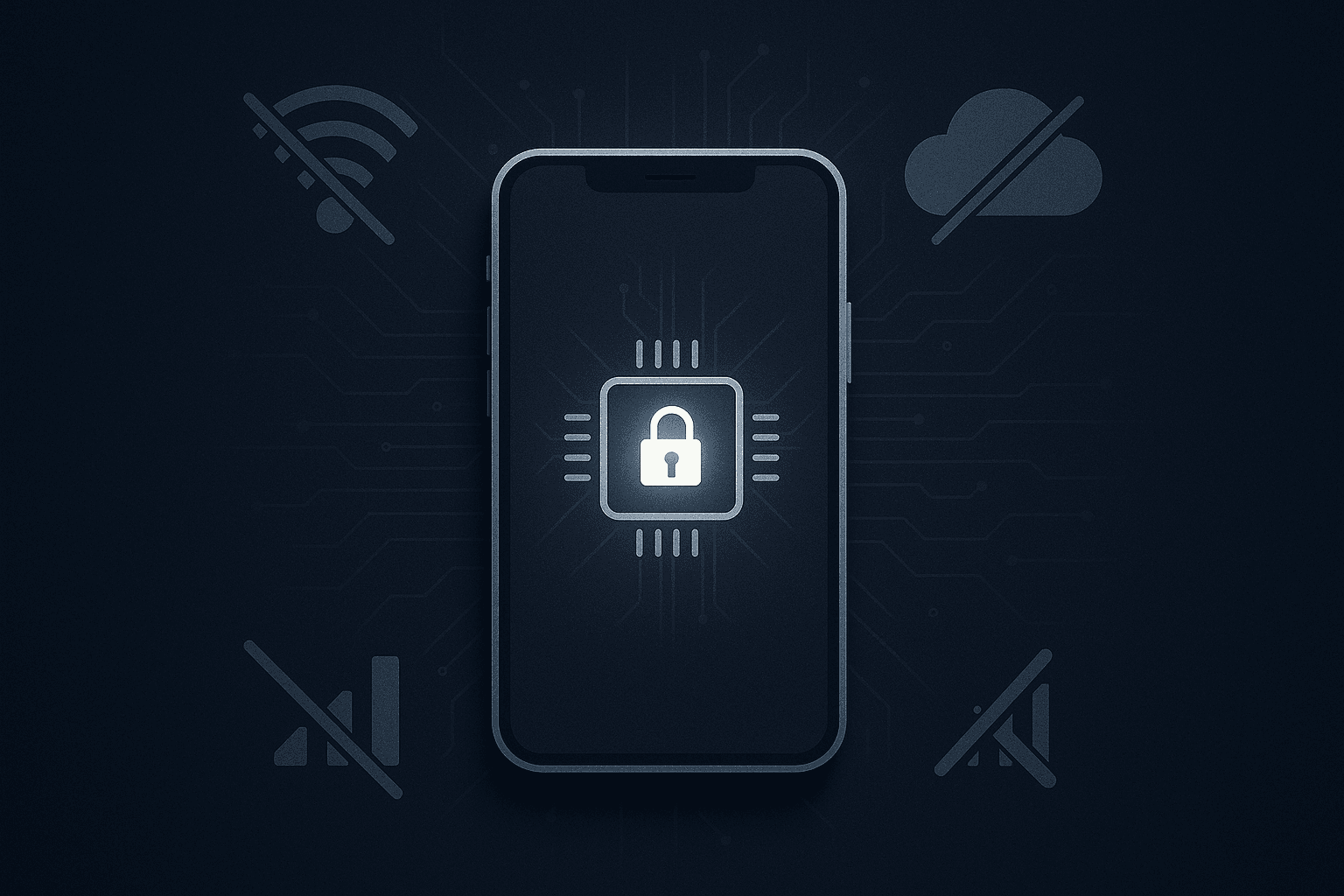
UltraLocked contains no networking code. Files never leave the device. There are no cloud sync options, no backup services, no account creation, no authentication servers. The application functions identically in airplane mode as it does with full connectivity—because it never uses connectivity.
This eliminates several attack categories entirely. Network interception: impossible. Man-in-the-middle attacks: not applicable. Server-side vulnerabilities: no servers exist. Account compromise: no accounts to compromise. Legal compulsion of service providers: no provider has access to demand.
The tradeoff is explicit: files stored in UltraLocked aren't accessible from other devices. They can't be recovered if the device is lost. This makes UltraLocked unsuitable for files that need cross-device access or guaranteed recoverability. But for professionals storing sensitive documents—draft legal briefs before filing, pre-announcement M&A documents, patient records requiring HIPAA compliance, or research data on controversial topics—the tradeoff is acceptable. These files don't need cross-device sync. They need protection from unauthorized disclosure.
Plausible Deniability and Emergency Protocols
High-risk individuals face scenarios where device access might be demanded under coercion—border crossings in hostile jurisdictions, physical security threats, or legal compulsion where assertion of rights carries consequences.
UltraLocked includes duress codes: alternative PINs that open a decoy vault while triggering secure deletion of actual sensitive files. The decoy vault contains plausible but non-sensitive content. The interface provides no indication that duress mode is active. An adversary who demands and receives device access sees a working vault with files—but not the files that actually required protection.
Dead Man's Switch protocols automatically wipe the vault if the user doesn't check in within a configured timeframe. A professional traveling internationally could set a 72-hour timer. Failure to check in triggers automatic secure deletion. Self-destruct timers can be attached to individual files—temporary access to documents that automatically delete after a specified period, with no recovery possible.
These aren't hypothetical scenarios. Journalists protecting source materials, security researchers with exploit code, executives traveling with pre-announcement financials, and attorneys with privileged communications all face situations where the ability to provably eliminate access to sensitive files is valuable. Not suspicious—valuable.
What Professionals Handling Sensitive Files Should Demand
The Patel breach demonstrates that position and awareness don't guarantee security when the architecture itself is vulnerable. Professionals handling sensitive information need to adopt a threat model that assumes sophisticated adversaries and asks different questions about storage architecture.
Assess whether files genuinely need network accessibility. M&A documents before announcement, privileged attorney-client communications, patient records, and pre-publication research don't need real-time cloud sync. They need protection from unauthorized disclosure. Store them in hardware-encrypted, offline-first vaults rather than email attachments or cloud drives.
Demand cryptographic isolation for sensitive files. Each file should have a unique encryption key with no cryptographic relationship to other files. Reject solutions that use a single master password to protect all files—compromising the master password compromises everything.
Verify hardware-anchored security. Software-only encryption stores keys in device memory where they're vulnerable to extraction. Hardware security modules like Secure Enclave generate and store keys in physically isolated chips where extraction is architecturally prevented, not just computationally difficult.
Implement time-based access controls. Files don't need to persist indefinitely. Self-destruct timers and Dead Man's Switch protocols provide guardrails for scenarios where maintaining persistent access creates more risk than value.
Plan for coerced access scenarios. Professionals operating in high-risk environments—international travel, controversial litigation, sensitive research—should have protocols for situations where device access might be demanded. Duress codes and provable data destruction aren't paranoia. They're contingency planning for known threat scenarios.
The goal isn't perfect security—that doesn't exist. The goal is matching security architecture to threat model. Professionals who are individually targeted by nation-state adversaries need different security than average users concerned about opportunistic threats. Network-accessible storage serves many use cases well. Protecting sensitive files against sophisticated adversaries isn't one of them.
Kash Patel's personal email breach won't be the last high-profile compromise. Nation-state cyber capabilities continue advancing faster than defensive measures. Professionals who handle sensitive information can't rely on perimeter defenses to protect files that represent valuable intelligence targets.
The solution isn't paranoia or disconnection. It's architectural alignment—matching storage choices to actual threats. Files that would cause significant harm if disclosed don't belong in systems designed for network accessibility. Hardware-anchored, offline-first storage eliminates attack vectors that no amount of password complexity or multi-factor authentication can address. That's not a philosophical preference. It's a recognition that some files are valuable enough to justify the tradeoffs that true security requires.