How Duress Codes Protect Sensitive Data Under Coercion
A Duress Code opens a decoy vault while silently destroying your real data when you're forced to unlock under coercion. Here's how it works.
What It Is
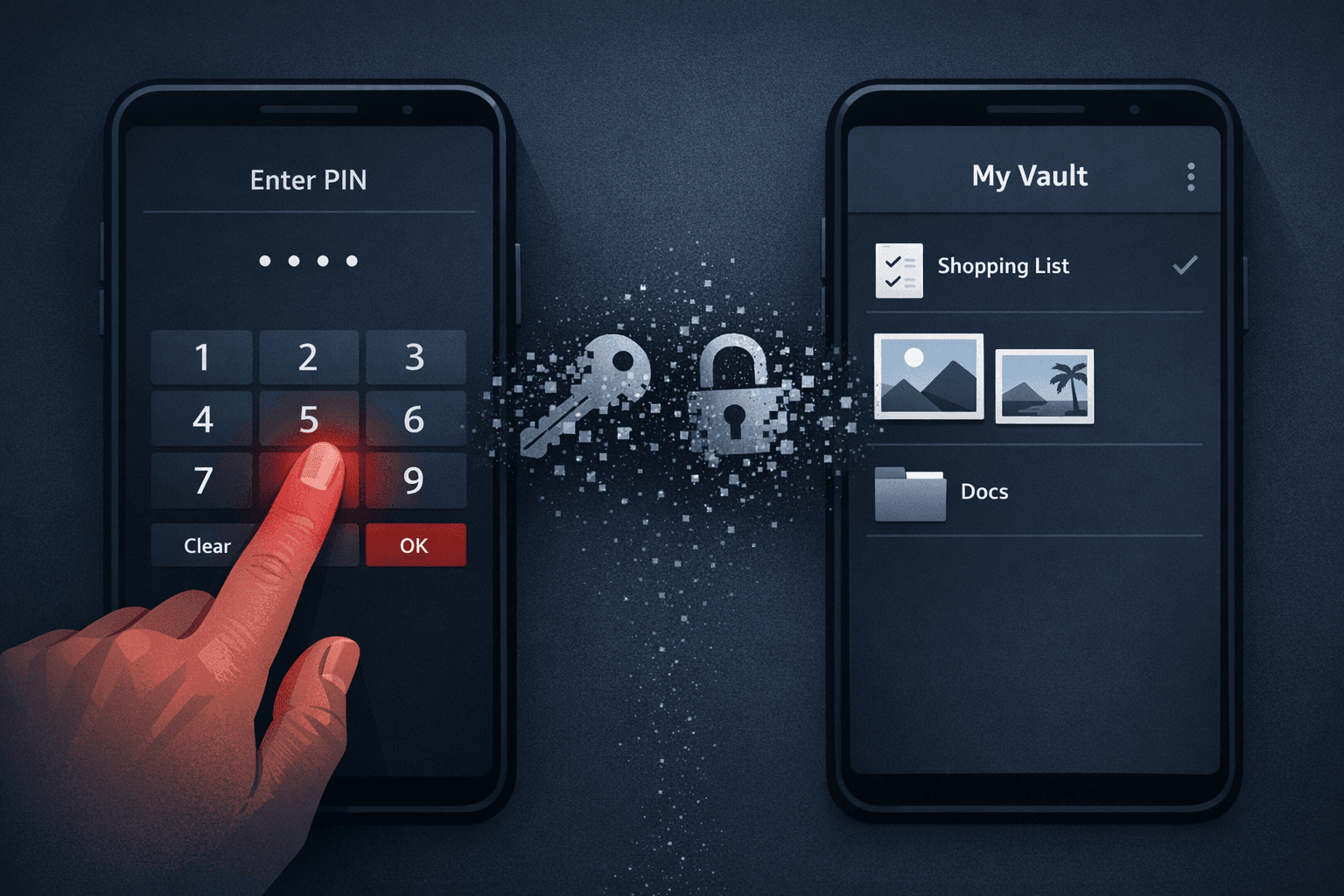
A Duress Code is a secondary PIN that triggers two actions simultaneously: it opens a convincing decoy vault while permanently destroying the encryption keys and data in your real vault. The feature exists for scenarios where someone forces you to unlock your device—whether through physical threat, legal coercion, or border crossing demands. Instead of revealing sensitive information or refusing to comply (which confirms you have something to hide), entering the Duress Code makes the app appear to unlock normally while ensuring your actual data becomes permanently unrecoverable.
The mechanism is intentionally irreversible. Once triggered, there's no backup, no recovery option, no "undo" button. The design philosophy treats data destruction as preferable to forced disclosure in genuinely high-risk situations. The decoy vault contains mundane, believable content that passes casual inspection—shopping lists, generic photos, innocuous notes. To an observer, the unlock process looks identical to normal operation. The real vault's destruction happens silently in the background through secure key erasure and file overwriting.
This isn't a feature for everyday use or as protection against forgetting your main PIN. It's an emergency protocol for situations where the stakes warrant permanent data loss as the lesser harm.
The Security Gap
Traditional password managers and secure vault applications operate on a binary model: locked or unlocked. This model assumes users maintain control over when and whether to provide access. That assumption breaks down in situations involving physical coercion, legal compulsion at borders, or threats to personal safety. Simply refusing to unlock confirms the presence of sensitive data worth protecting—which can escalate the threat.
Most security architectures focus on preventing unauthorized access through strong encryption and authentication. These protections work well against remote attackers or theft of an idle device. They offer little defense when someone with physical access demands you unlock the device while watching. Biometric authentication compounds this vulnerability—fingerprints and faces can be captured or forced without cooperation, and many jurisdictions have ruled that biometric unlocking can be legally compelled in ways that password disclosure cannot.
The conventional alternative—refusing to comply—carries its own risks. At international borders, refusal can result in device seizure, denied entry, or detention. In situations involving physical threat, refusal isn't always viable. Some users attempted workarounds like maintaining separate "clean" devices for border crossings or keeping sensitive data off mobile devices entirely. These approaches work but require significant operational overhead and planning.
The gap exists between "grant full access" and "refuse access entirely." Duress Codes create a third option: apparent compliance that provides plausible deniability while ensuring actual sensitive data becomes inaccessible to everyone, including the device owner.
How It Works
The Duress Code mechanism relies on the system treating two different PINs as valid authentication, each leading to entirely different outcomes. During initial setup, users configure both a primary PIN (which unlocks the real vault) and a distinct Duress PIN. The authentication system stores both PINs but associates them with different vault identities.
When someone enters the primary PIN, the application decrypts the main vault's encryption keys from secure storage and uses them to decrypt the vault contents. Standard unlock process—the real data becomes accessible and remains intact.
When someone enters the Duress PIN instead, three things happen in rapid succession. First, the application recognizes the Duress PIN as valid authentication—no error message, no failed attempt counter, no indication that anything unusual occurred. Second, it decrypts and displays a pre-configured decoy vault that contains innocuous content. The decoy vault is a fully functional vault environment populated with mundane data that appears legitimate during casual inspection. Third, in the background while the decoy vault displays, the application locates the real vault's encryption keys in secure storage and overwrites them with random data multiple times. Then it overwrites the encrypted vault files themselves. The timing is calibrated to complete data destruction before someone watching closely would notice any unusual delay.
The decoy vault can be populated during setup with whatever content seems appropriate for plausible deniability. Generic photos, shopping lists, password entries for common services with disposable credentials. The content should look used but boring—something that explains why the device is locked without suggesting anything worth concealing. The decoy persists after the Duress Code is entered, allowing continued interaction with the app without revealing that destruction occurred.
Users configure the Duress Code through the application's emergency protocols settings. The setup process requires an existing primary PIN and walks through creating a distinct Duress PIN plus populating the decoy vault. The interface emphasizes the permanence of the action and requires explicit confirmation that users understand data recovery won't be possible.
For journalists crossing borders with sensitive source information, entering the Duress Code at a checkpoint results in apparent compliance with inspection demands while ensuring source-identifying details become unrecoverable. For individuals in domestic violence situations where partners demand device access, the Duress Code allows apparent transparency while protecting documentation of abuse or escape planning. For activists operating in hostile jurisdictions where arrest and device search are credible threats, the feature provides a last-resort option when secure deletion before capture isn't possible.
Real-World Applications
International Travel and Border Crossings
Border agents in multiple countries have legal authority to demand device passwords and inspect contents as a condition of entry. Refusal can result in device seizure, denied entry, or secondary screening that delays travel by hours or days. Journalists, lawyers, and activists who travel internationally often carry devices containing confidential communications, source identities, or legally privileged information that shouldn't be disclosed but whose existence can't be easily hidden.
Someone arriving at a border checkpoint can enter their Duress Code when demanded to unlock their device. The agent sees a functional vault application containing innocuous personal data—password entries for email and shopping sites, some family photos, notes about travel itineraries. Nothing suggests the device previously contained anything more sensitive. The actual confidential material has been destroyed during the unlock process. The traveler complies with the legal demand while ensuring protected information doesn't become accessible to border authorities.
Domestic and Personal Safety Situations
Domestic violence situations often involve monitoring and control of devices. Abusers may demand access to phones to read messages, check locations, or verify compliance with restrictions. Victims planning to leave may use secure vaults to store evidence of abuse, contact information for shelters, financial account details, or legal documents. Discovery of this information can escalate danger significantly.
If confronted with a demand to unlock the device, entering the Duress Code shows an apparently transparent device while ensuring documentation of abuse and escape resources become unrecoverable by the abuser. The apparent compliance reduces immediate confrontation risk while preventing the information from being used to track or prevent leaving. The data loss is acceptable because the alternative—disclosure—poses greater danger.
Political Activism and Journalism
Operating in jurisdictions with authoritarian governments or covering sensitive topics creates persistent risk of detention and device search. Activists and journalists often possess contacts, source identities, communication records, or documentation that could endanger others if disclosed. Secure deletion before arrest isn't always possible if detention happens unexpectedly.
During detention, authorities can apply pressure to unlock devices—through legal demands, extended detention, or direct threats. Entering a Duress Code appears to comply while ensuring source identities and sensitive contacts become permanently inaccessible. The decoy vault might contain public materials, published articles, or innocuous communications that align with legitimate professional activity without revealing confidential sources or organizational details.
Technical Details
The duress mechanism relies on cryptographic key destruction rather than just file deletion. Simply deleting files leaves data recoverable through forensic techniques that examine raw storage. The destruction process specifically targets the encryption keys stored in the device's secure enclave or keystore. Without these keys, the encrypted vault data remains on storage but becomes cryptographically impossible to decrypt—equivalent to random noise.
After key destruction, the system performs multiple overwrite passes on the encrypted vault files themselves. The number of passes balances thoroughness against the need to complete destruction quickly enough to avoid noticeable delay. Modern flash storage with wear-leveling makes single-pass overwriting less reliable than it was on traditional hard drives, but combined with key destruction, the multi-layered approach ensures data recovery requires resources beyond most threat scenarios.
The decoy vault exists as a separate, independently encrypted container. It has its own encryption keys, associated with the Duress PIN rather than the primary PIN. During normal operation (unlocking with the primary PIN), the decoy vault remains encrypted and inaccessible. During duress operation (unlocking with the Duress PIN), the real vault's keys are destroyed while the decoy vault's keys are used for decryption. The two vaults never exist in a decrypted state simultaneously.
The authentication system uses constant-time comparison for PIN validation to prevent timing attacks that might distinguish between primary and duress PINs based on processing time differences. Failed PIN attempts increment a single counter regardless of whether the attempt was closer to the primary or duress PIN, preventing enumeration attacks.
The feature operates entirely on-device. No network connection is required or used during the duress process. This ensures the mechanism functions in airplane mode or areas without connectivity, and prevents network traffic patterns from revealing that destruction occurred.
Getting Started
Setting up a Duress Code requires navigating to the application's Settings menu and selecting Duress Protection. The setup process requires an existing primary PIN and guides users through creating a distinct Duress PIN. During setup, users can populate the decoy vault with whatever content seems appropriate for their threat model—the more believable and used it appears, the more effective the plausible deniability.
The setup interface includes explicit warnings about the permanence of data destruction and requires confirmation that users understand the consequences before enabling the feature.
Key Benefits
The Duress Code creates a middle option between full disclosure and outright refusal when forced to unlock a device. It provides plausible deniability through a convincing decoy while ensuring actual sensitive data becomes permanently inaccessible through cryptographic key destruction and secure overwriting. The mechanism operates entirely on-device without network dependencies and completes quickly enough to avoid suspicious delays during unlock.
The feature addresses scenarios where traditional security measures—strong encryption, biometric authentication, secure passwords—provide inadequate protection because the threat involves physical coercion or legal compulsion rather than remote attack. For users facing border crossings with sensitive material, domestic safety situations requiring evidence protection, or activism in hostile jurisdictions, permanent data destruction can be preferable to forced disclosure.